
HSM & SAM devices
A hardware root of trust for cryptographic keys.
HSM & SAM devices from Thales Luna, Utimaco u.trust and i4p TRIDENT: key protection for PKI, digital and remote signing and encryption; delivered by CyberLotus.



- 01Thales Luna Network HSMLuna 8 · Luna 7 · 1U network HSM
- 02Thales Luna PCIe, USB, BackupPCIe card · offline HSM · key backup
- 03Thales ProtectServer 3HSM running custom firmware
- 04Utimaco u.trust GP HSMSe-Series · CSe-Series · multi-tenant
- 05Utimaco CC eIDASQSCD for trust services
- 06i4p TRIDENTHSM · MPC · RSS (SAM) · NSA
What does HSM & SAM help with?
An HSM generates, stores and uses cryptographic keys inside tamper-resistant hardware: keys never leave the device in clear. It is the root of trust for PKI, digital signatures, remote signing, timestamping and data encryption.
Keys never leave the hardware
Generate, store and use keys inside a tamper-resistant boundary; MofN authorisation and multi-factor authentication.
International certifications
FIPS 140-3, Common Criteria EAL4+ to EN 419 221-5 and eIDAS QSCD, depending on the product line.
Remote signing with a SAM
TRIDENT RSS ships with a Signature Activation Module certified to Common Criteria under EN 419 241-2.
Multi-tenant, shared
Up to 31 isolated HSM containers (u.trust) or 30 instances (Luna 8) on one appliance.
Post-quantum ready
ML-KEM, ML-DSA, SLH-DSA on Luna 8 and TRIDENT; the Quantum Protect package for u.trust.
Many form factors
1U network appliances, PCIe cards, offline USB HSMs and key backup devices.
What are HSMs and SAMs?
A Hardware Security Module (HSM) is tamper-resistant hardware that generates, stores and uses cryptographic keys inside the device boundary: keys never leave the HSM in clear. The HSM is the root of trust for PKI, digital signatures, remote signing, timestamping, data encryption, electronic transactions and digital identity.
A Signature Activation Module (SAM) is the component that activates signatures in remote signing: it ensures each signer's key is only used when that signer authenticates and consents. The SAM runs inside the HSM's protected boundary and is evaluated under EN 419 241-2.
CyberLotus offers HSM and SAM products from Thales, Utimaco and i4p, with advice on selection, deployment and integration with digital signing platforms.
Product portfolio
| Vendor | Product line | Form factor | Highlights |
|---|---|---|---|
| Thales | Luna 8 Network HSM (Luna 100, 150, 190) | 1U network appliance | Two crypto modules, up to 30 HSM instances; post-quantum ready |
| Thales | Luna Network HSM 7 (A/S 700, 750, 790) | 1U network appliance | Up to 10,000 RSA-2048 tps; CC EAL4+, QSCD |
| Thales | Luna PCIe HSM (A/S 700, 750, 790) | PCIe card | Dedicated HSM inside a server, low latency |
| Thales | Luna USB HSM U700 | Portable | Offline key storage for Root CAs; FIPS 140-3 Level 3 |
| Thales | Luna Backup HSM (B700, B750, B790) | Portable | Hardware key backup for up to 100 partitions |
| Thales | ProtectServer 3 / 3+ | Network appliance | Runs custom firmware inside the HSM |
| Utimaco | u.trust GP HSM Se-Series (Se100 to Se40k) | 1U appliance, PCIe card | Up to 40,000 RSA-2048 signatures/s; 31 HSM containers |
| Utimaco | u.trust GP HSM CSe-Series (CSe100, 2k, 5k) | 1U appliance, PCIe card | Tamper-active protection, erases keys when attacked |
| Utimaco | CC eIDAS on CryptoServer | 1U appliance, PCIe card | CC EAL4+ (EN 419 221-5), QSCD for trust services |
| i4p | TRIDENT HSM, TRIDENT MPC | 1.5U rack appliance | Multi-party computation: no device ever holds a whole key |
| i4p | TRIDENT RSS (Remote Signature Solution) | 1.5U rack appliance | Built-in SAM certified CC EAL4+ (EN 419 241-2) for remote signing |
| i4p | TRIDENT NSA (Network Security Appliance) | 1.5U rack appliance | Real-time duplex encryption of network links |
Thales Luna and ProtectServer
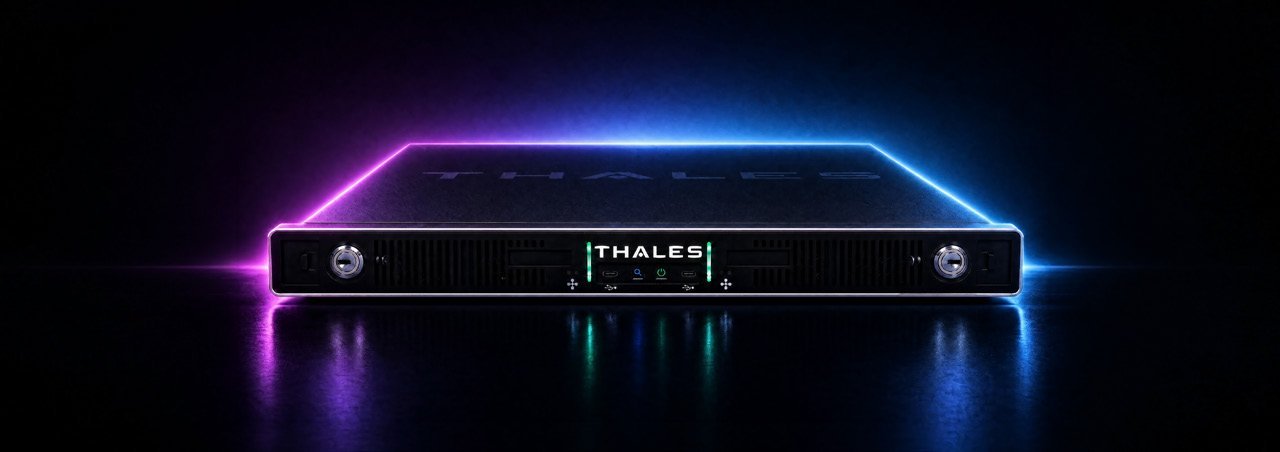
Luna 8 Network HSM uses Thales-designed crypto processors: two independent modules, each hosting up to 15 isolated HSM instances (up to 30 per appliance, 10 partitions each). It supports ML-KEM (FIPS 203), ML-DSA (FIPS 204) and LMS/HSS signatures, with two on-board entropy sources including a QRNG, and 20 times the energy efficiency per transaction of Luna 7. Models: Luna 100 (1 container, 128 MB), Luna 150 (up to 6, 1 GB), Luna 190 (up to 15, 4 GB).
Luna Network HSM 7 is certified Common Criteria EAL4+ to EN 419 221-5 and listed as an eIDAS QSCD. A models use password authentication, S models multi-factor PED authentication: A/S700 up to 1,000 RSA-2048 tps, A/S750 up to 5,000 tps, A/S790 up to 10,000 RSA-2048 and 22,000 ECC P256 tps with up to 100 partitions.
- Luna PCIe HSM: a low-profile card with the same model performance as Luna 7; suits timestamping, dedicated signing servers and OEM security appliances.
- Luna USB HSM U700: a portable FIPS 140-3 Level 3 HSM with a touch screen, powered over USB-C, for offline Root CA keys.
- Luna Backup HSM B700, B750, B790: hardware key backup and restore for up to 100 partitions, 32 MB to 256 MB.
- ProtectServer 3 / 3+: a steel-cased network HSM that runs custom firmware (Functionality Modules), with a software emulator for development; up to 1,300 RSA-2048 signatures per second.
Utimaco u.trust General Purpose HSM
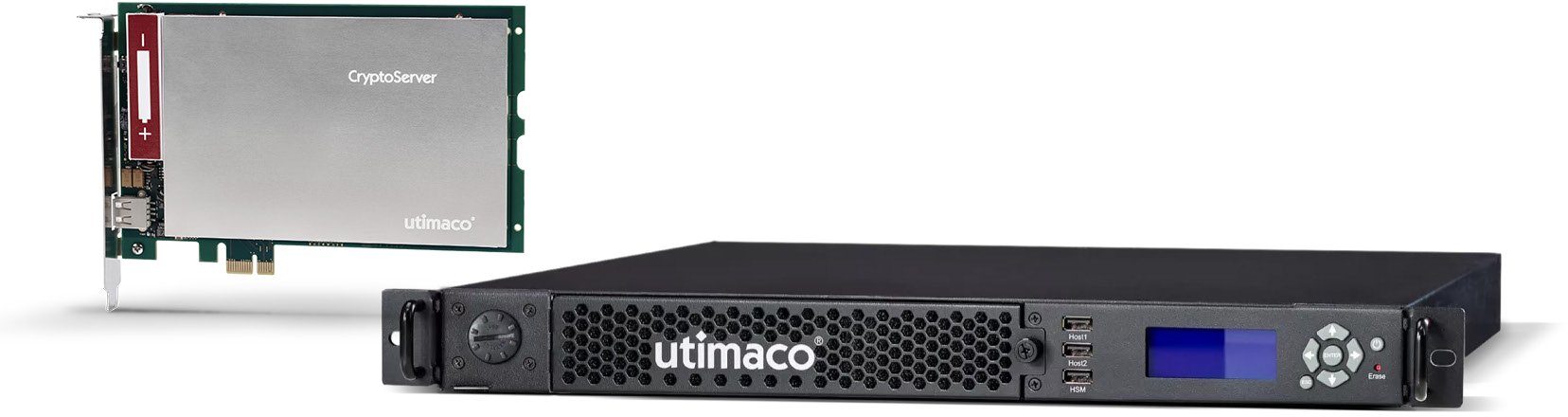
Utimaco (Aachen, Germany) builds the u.trust General Purpose HSM line for banks, governments, telecoms and trust service providers. All algorithms are included; extended functions come as packages: Quantum Protect, 5G Protect, Blockchain Protect, Timestamp, Double Key Encryption and an SDK. Up to 1, 4, 8, 16 or 31 fully isolated HSM containers run on one device.
| Edition | Models, performance | Certification, highlights |
|---|---|---|
| u.trust Se-Series | Se100, Se2k, Se5k, Se15k, Se40k: 101 to 40,000 RSA-2048 signatures/s | FIPS 140-3 Level 3, CC EAL4+; multi-tenant, PQC ready; as-a-service option operated by Utimaco |
| u.trust CSe-Series | CSe100, CSe2k, CSe5k: up to 5,000 RSA-2048 and 10,500 ECDSA P-256 signatures/s | Active sensor mesh erases keys when attacked; FIPS 140-3 Level 4 (physical security)* |
| CC eIDAS on CryptoServer | Up to 3,000 RSA and 2,500 ECDSA signatures/s (batch) | CC EAL4+ (EN 419 221-5), QSigCD and QSealCD; SAM development to EN 419 241-2 with the SDK |
i4p TRIDENT: HSM, MPC, RSS and NSA

According to i4p, TRIDENT HSM is the first physical HSM to apply secure multi-party computation to cryptographic operations. In the MPC cluster mode, a secret key never exists in full on any device, whether generated, stored or used; signing and decryption run on all or n of k devices.
- TRIDENT HSM: Common Criteria EAL4+ to EN 419 221-5, the base of every TRIDENT device.
- TRIDENT MPC: each device holds only a key share; RSA, ECC and AES in multi-party mode.
- TRIDENT RSS: a built-in Signature Activation Module certified CC EAL4+ to EN 419 241-2 for qualified remote signatures and seals.
- TRIDENT NSA: adds real-time duplex encryption for high-speed network links.
TRIDENT's tamper detection module monitors the device even without power, local applications run in isolated containers, and ML-KEM, ML-DSA and SLH-DSA run alongside classical algorithms.
Choosing an HSM by use case
| Use case | Suggestion |
|---|---|
| Offline Root CA key | Luna USB HSM with MofN authentication |
| Online CA, central signing | Luna Network HSM or u.trust Se clusters in HA |
| Remote signing, trust services needing a QSCD | TRIDENT RSS (SAM EN 419 241-2 + HSM EN 419 221-5), CC eIDAS on CryptoServer, Luna 7 or Luna PCIe |
| Very high signing volume | u.trust Se15k, Se40k (up to 40,000 RSA-2048 signatures/s) or Luna 7 A790/S790 |
| Timestamping, dedicated signing servers | Luna PCIe or a u.trust Se PCIe card (Timestamp package), at least two cards in two servers |
| High physical intrusion risk | u.trust CSe-Series or TRIDENT |
| High-value keys without a single point of compromise | A TRIDENT MPC cluster |
| Post-quantum roadmap | Luna 8, TRIDENT, or u.trust Se, CSe with Quantum Protect |
| Key backup, disaster recovery | Luna Backup HSM or a standby HSM cluster at the DR site |
A typical PKI and signing architecture recommended by CyberLotus: an offline HSM for the Root CA; two-site HA HSM clusters for issuing CAs and remote signing; PCIe HSMs for timestamping; at least two key backup devices, one kept at the DR site. HSMs connect to the SignServer central signing server, the SignHub signing platform and the CorpCA dedicated e-signature system.
Notes for selection and tenders
- FIPS 140-2 moves to Historical: from 21 September 2026, FIPS 140-2 certificates remain usable for existing systems but are no longer Active for new procurement. Vendor documents list only FIPS 140-2 for some lines (Luna 7, Luna PCIe, ProtectServer 3, CryptoServer CSe); verify the FIPS 140-3 certificate of the specific model before quoting.
- Certifications in progress: some certifications of Luna 8, Luna Backup HSM, u.trust Se, CSe and TRIDENT are listed by the vendors as in progress; check the NIST CMVP list and the certification bodies when preparing a bid.
- Performance and sizing: Luna 8 and TRIDENT do not publish per-algorithm performance; obtain sizing figures or run a proof of concept under the real workload.
- eIDAS and QSCD are European Union frameworks; in Vietnam they are a quality reference and do not replace the technical requirements of Vietnamese regulators.
- Civil cryptographic products: the import, sale and use of HSMs in Vietnam follow sector regulations.
* Listed by the vendor as in progress when the document was published.
CyberLotus services
- Architecture advice: vendor and HSM line comparison, sizing, HA/DR design and security level planning.
- Supply and deployment: installation, documented key generation ceremony, application integration.
- Signing platform integration: connecting HSMs to SignServer, SignHub and the organisation's CA.
Compiled from the official Product Briefs and Datasheets of Thales, Utimaco and i4p; specifications may change with hardware and firmware versions. Thales, Utimaco and i4p names and logos belong to their respective owners. The product catalogue is available in Vietnamese.
Focused on your business.
Choose by use case: CyberLotus advises on the vendor, product line and configuration.
CA, PKI and Root CA
Luna Network HSM or u.trust Se clusters in HA for issuing CAs; an offline Luna USB HSM for the Root CA key.
Digital and remote signing
TRIDENT RSS (SAM EN 419 241-2), CC eIDAS on CryptoServer, Luna 7 or Luna PCIe for trust services.
High-volume signing
u.trust Se40k up to 40,000 RSA-2048 signatures per second; Luna 7 A790/S790 up to 10,000 tps.
Timestamping, signing servers
Luna PCIe or a u.trust Se PCIe card (Timestamp package); at least two cards in two servers.
High physical risk
u.trust CSe-Series erases keys when attacked; TRIDENT monitors tampering even without power.
High-value keys, multi-party
A TRIDENT MPC cluster: no device ever holds a whole key; n-of-k threshold.
A clear implementation journey.
CyberLotus supports you from device selection to running your digital trust infrastructure.
Architecture advice
Compare vendors and HSM lines; size for the real workload; design HA, DR and the security level plan.
Supply and install
Supply and install devices; run a documented key generation ceremony.
Integrate applications
Connect HSMs to the CA, SignServer, SignHub and business apps via PKCS#11, JCE, CNG and OpenSSL.
Operate and back up
Key backup and recovery at the DR site; training, handover and technical support.