
Secure dedicated electronic signature solution
Own your signatures, with legal effect.
Run your own dedicated CA
Instead of buying public certificates per user with recurring annual costs, the organisation controls the whole certificate lifecycle.
Issue and revoke with HR data
Certificates are issued and revoked in sync with HR data (HRM, LDAP/AD), with no waiting on an external CA when staff change.
Your own OCSP/CRL
Certificate status services run on the organisation's own systems instead of third-party infrastructure.
Legal effect once certified
A certified secure dedicated signature is equivalent to a handwritten signature in dealings with outside parties (Law on Electronic Transactions, Article 23).
What is CorpCA?
CorpCA is a PKI (public key infrastructure) platform that lets agencies and organisations create and manage their own secure dedicated electronic signatures, based on digital signature technology, under Vietnam's Law on Electronic Transactions No. 20/2023/QH15 and Decree 23/2025/ND-CP. Signatures backed by certificates issued by the organisation itself are deemed to meet the requirements of Article 22(2) of the Law on Electronic Transactions (Decree 23/2025/ND-CP, Article 9(1)).
CorpCA is built for banks, insurers, securities firms, groups and listed companies with thousands of signers and many member entities: one signature infrastructure for the whole organisation, self-managed, integration-ready and legally effective once certified.
Permitted scope of use
Under Article 9(2) of Decree 23/2025/ND-CP, an organisation's secure dedicated signatures may be used in three scopes:
| Scope | Use | Legal basis |
|---|---|---|
| Internal | Directives, e-Office, approvals, internal vouchers | Article 9(2)(a) |
| Affiliated entities | Groups, corporations and member entities linked by their charter | Article 9(2)(b) |
| On behalf of the organisation | Contracts and documents sent to partners and customers | Article 9(2)(c) |
The organisation does not issue certificates to customers or individuals outside the organisation and does not sell dedicated signature services (Law on Electronic Transactions, Article 25(1)).
Typical use cases
- Banking, insurance, securities: staff sign proposals, approvals and internal vouchers in e-Office, core banking and LOS; the organisation signs documents sent to customers with its own signature.
- Groups and listed companies: one dedicated CA serving the parent company and member entities linked by their charter, signing contracts and documents in ERP and e-Contract systems.
Solution architecture
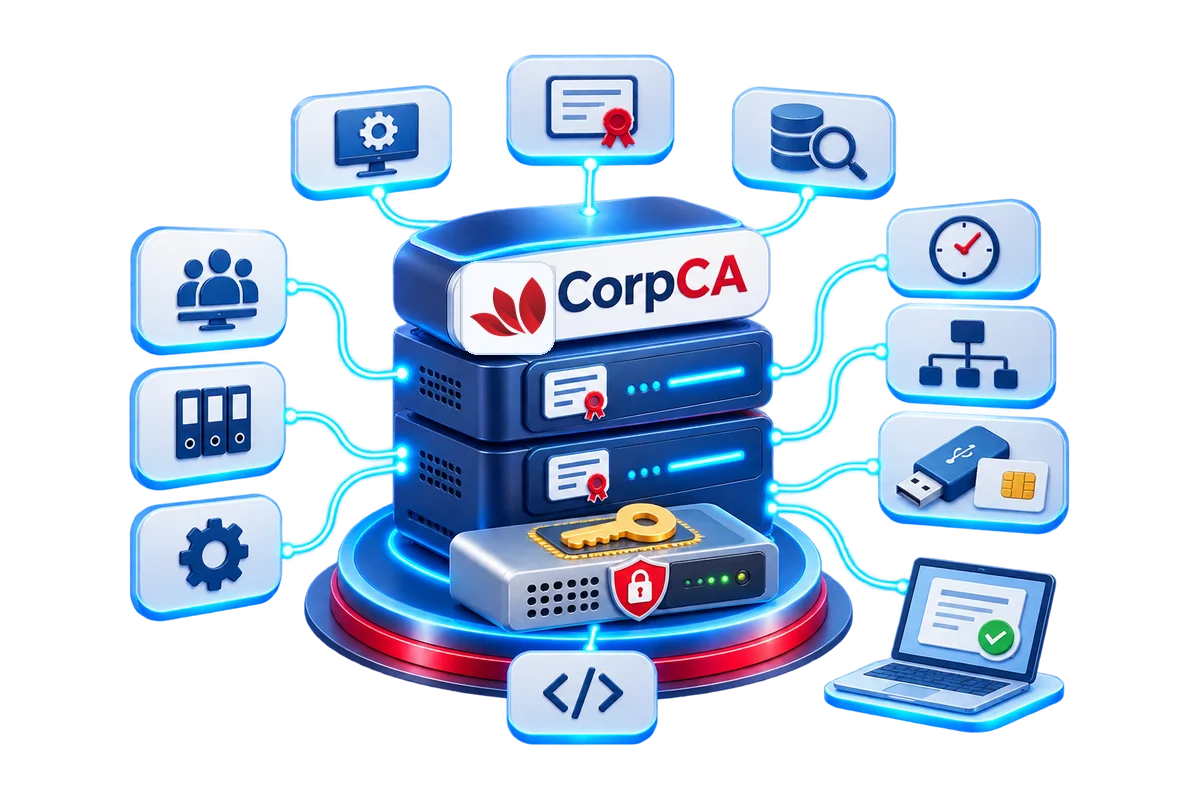
CorpCA runs on the organisation's own infrastructure, split into three network zones:
- CA core zone: Root CA (offline), Issuing CA on EJBCA, LotusPanel (RA), the database and an HSM protecting the CA keys.
- Internal zone: LDAP directory, LotusTMS for USB token and smart card management, and OpenAPI for business applications.
- DMZ: VA (OCSP, CRL) so outside relying parties can check certificates, a TSA for timestamps, and LotusPortal for users.
- Integration: RESTful OpenAPI, .NET/Java API, HTTPS and LDAP with HR systems (HRM, AD/LDAP), e-Office, ERP, core, CRM and the organisation's signing software such as SignServer and SignClient.
Technical specifications
| Item | Specification |
|---|---|
| Components | Core CA (Root CA, Issuing CA), RA – LotusPanel, VA – OCSP & CRL, TSA – timestamps, LDAP, LotusTMS (token management), LotusPortal (user portal), OpenAPI |
| Core CA platform | EJBCA Community Edition with CyberLotus technical support, or EJBCA Enterprise (Keyfactor licence, charged separately) |
| Infrastructure | Linux; MSSQL, PostgreSQL, MariaDB databases; VMware ESXi virtualisation; Kubernetes (Premium package) |
| HSM | Connected via PKCS #11; FIPS 140-3 Level 3 or EN 419221-5 HSMs recommended (existing FIPS 140-2 Level 3 devices still supported) |
| User key storage | USB token, smart card, HSM; FIPS 140-2/140-3 Level 2 tokens and smart cards recommended; central token management with LotusTMS |
| Algorithms | RSA ≥ 2048 bit (PKCS #1 v2.2 – RFC 8017, RSASSA-PSS); ECDSA ≥ 256 bit (NIST, Brainpool curves); SHA-2 (from SHA-256), SHA-3 hashes; no SHA-1 for signatures |
| Certificates | X.509 v3 and CRL v2 (RFC 5280); minimum content per Decree 23/2025 Article 5; configurable validity of up to 10 years (Article 7(4)) |
| Data formats | PKCS #10 (certificate requests); PKCS #8, PKCS #12; CMS (RFC 5652) |
| Certificate status | OCSP (RFC 6960); CRL distributed over HTTP (RFC 2585); run on the organisation's own systems |
| Timestamps | RFC 3161, RFC 5816 |
| Directory | LDAP v3 (RFC 4510–4513), PKI schema (RFC 4523) |
| Certification practice statement | RFC 3647 structure; content per the model CPS in Circular 16/2025/TT-BKHCN, Appendix IV |
| Integration | RESTful API (OpenAPI); .NET/Java API; HTTPS (TLS ≥ 1.2); HR data sync (HRM, LDAP/AD) |
| Administration | LotusPanel web interface for CA and RA administration; admin activity logs |
CorpCA packages
| Component | Standard | Professional | Premium |
|---|---|---|---|
| Core CA (Root CA, Issuing CA) | ● | ● | ● |
| VA – OCSP & CRL | ● | ● | ● |
| LotusPanel – RA | ● | ● | ● |
| LDAP | ● | ● | ● |
| TSA – timestamps | – | ● | ● |
| LotusTMS – token management | – | ● | ● |
| LotusPortal – user portal | – | – | ● |
| OpenAPI integration | – | – | ● |
| Kubernetes deployment | – | – | ● |
| EJBCA Community platform (CyberLotus support) | ● | ● | ● |
| EJBCA Enterprise licence | Optional* | Optional* | Optional* |
| HSM | Optional* | Optional* | Optional* |
| Servers, OS/database licences | Optional* | Optional* | Optional* |
* Optional, charged separately. Every package can run on EJBCA Community (with CyberLotus support) or EJBCA Enterprise. Pricing depends on the number of users.
Professional services
- Certification dossier consulting: application Forms 01 and 03 (system description, operating procedures, staffing) and the certification practice statement under Circular 16/2025/TT-BKHCN.
- Deployment and integration: survey, design, installation; integration with HRM, LDAP/AD and business applications.
- CA key ceremony and on-site assessment: running the key generation ceremony; support during the regulator's system assessment.
- Training and handover: for the organisation's CA, RA administration and operations teams.
- Support and maintenance: EJBCA Community technical support; operation and maintenance; help with the Form 08 report on certificate renewal.
Legal notes
- Certification is granted to the organisation after its dossier is reviewed and its system assessed on site (Decree 23/2025/ND-CP, Article 11). CorpCA provides the technical platform; the organisation is responsible for its policies, staffing and operations (Article 9(3)).
- Dedicated signatures are validated under conditions agreed between the parties (Law on Electronic Transactions, Article 22(2)(d)). The organisation should agree terms with relying parties and publish its root certificate and OCSP/CRL services so they can validate signatures.
- CorpCA's TSA serves the organisation's own needs. Timestamps used to prove signing time to third parties must come from a licensed timestamping service provider (Decree 23/2025/ND-CP, Article 32).
Learn more about CorpCA.
Products that work together.
An initial suggestion to explore, not a fixed solution configuration.
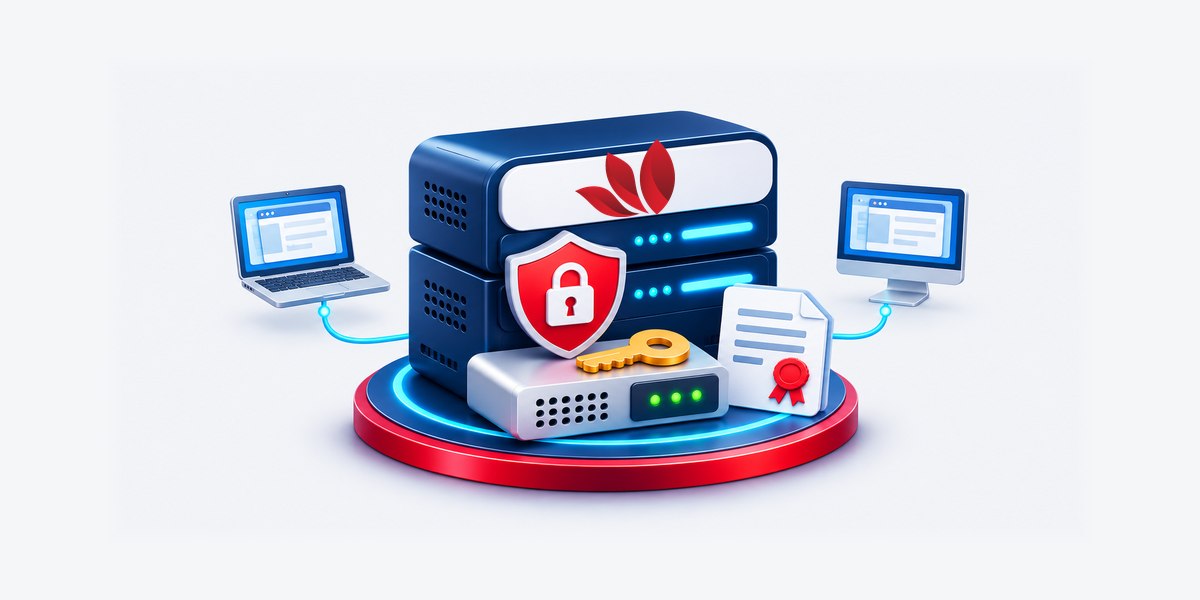
SignServer
On-premise centralised signing server: signing keys kept on HSMs, automated PDF, XML and JSON signing via REST API or Message Queue, no USB tokens.
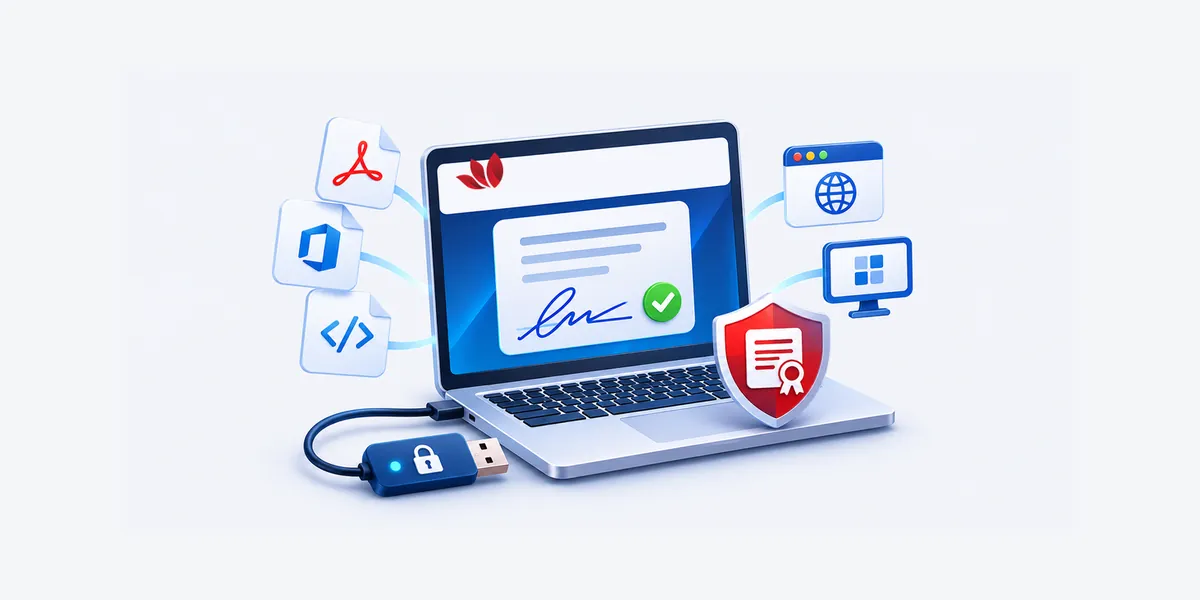
SignClient
Workstation signing software for USB tokens: one plugin and one REST API so web and desktop apps can sign PDF, Office and XML and validate signatures.
Documents for download.
Brochure CorpCA
Hệ thống chữ ký điện tử chuyên dùng · Private CA System
Download