
OpenText OSM
IT infrastructure monitoring and service management.
OpenText OSM: ITOM and ITSM software for network, infrastructure and application monitoring and ITIL service management; delivered by CyberLotus.

- 01Network Node ManagerNetwork discovery, fault and performance
- 02Network Operations ManagementAdds configuration, change and compliance
- 03Network ObservabilityHybrid networks · Aviator AI · SaaS
- 04Infrastructure ObservabilityAWS · Azure · GCP · Kubernetes · VMware
- 05Core Application ObservabilityOpenTelemetry · traces · metrics · logs
- 06Service ManagementITSM, ESM · CMDB · Aviator
What does OpenText OSM help with?
OpenText OSM (Observability and Service Management) covers network, infrastructure and application monitoring and IT service management along the path a signal takes: collect, diagnose, resolve, then improve within ITIL processes.
Discovery and topology
Spiral Discovery keeps the network map current; infrastructure and application service views are built automatically.
One view of hybrid IT
AWS, Azure, Google Cloud, Kubernetes, VMware and on-premises resources on one dashboard.
AI-assisted diagnosis
Multivariate anomaly detection (MVAD) and event correlation; OpenText Aviator suggests diagnostic actions.
Network configuration and compliance
Snapshot, compare and roll back configurations; policy-based control across 3,500+ device types.
Open OpenTelemetry standard
Instrument applications once, analyse anywhere; no vendor lock-in.
ITIL service management
Incidents, requests, changes, CMDB and assets on one AI-powered ITSM and ESM platform.
What is OpenText OSM?
OpenText OSM (Observability and Service Management) is OpenText's IT operations management (ITOM) and IT service management (ITSM) portfolio. Its six products monitor networks, infrastructure and applications, and handle every incident, request and change on one ITIL-based service management platform.
Hybrid networks, multiple clouds and on-premises systems split the operations picture across many tools: incidents are found late, root causes are hard to trace, and users cannot see where their requests stand. OpenText OSM arranges its six products along the path a signal takes through an IT organisation: collected at the network, infrastructure and application layers, diagnosed, then resolved and improved in service management processes.
Six products along the operations flow
| Layer | Product | Core capabilities | Deployment |
|---|---|---|---|
| Network | Network Node Manager (NNMi) | Discovery, topology maps, fault and performance monitoring | On-premises, some SaaS components |
| Network | Network Operations Management (NOM) | Adds configuration, change, compliance and automation | On-premises, some SaaS components |
| Network | Network Observability | Builds on NOM with hybrid cloud visibility and Aviator AI diagnostics | SaaS or on-premises |
| Infrastructure | Infrastructure Observability | Multi-cloud and on-premises monitoring, multivariate anomaly detection | SaaS, on-premises data via SiteScope |
| Application | Core Application Observability | OpenTelemetry traces, metrics, logs and service maps | SaaS |
| Service | Service Management (SMAX) | Incidents, requests, changes, CMDB, assets, Aviator AI assistant | SaaS, on-premises, AWS, Azure, Google Cloud |
Network layer: three maturity levels
The three network products build on each other: NNMi is the core of Network Operations Management, and Network Observability builds on NOM with cloud visibility, AI and a SaaS option. Organisations choose by the scope they need to manage and can upgrade step by step.
OpenText Network Node Manager (NNMi)
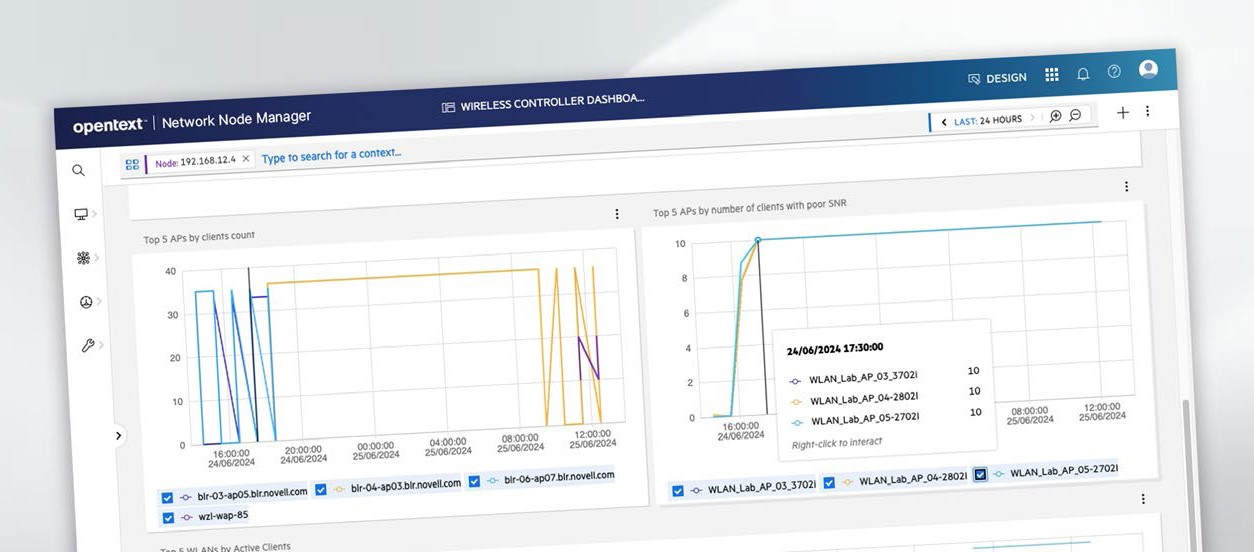
NNMi brings network fault and performance monitoring together. Data is correlated in real time so operators focus on high-priority incidents and cut mean time to repair (MTTR). Spiral Discovery keeps the topology map current, reflecting devices and connections across physical, virtual and SDN infrastructure. A distributed, federated architecture scales from small businesses to large networks without much extra hardware.
OpenText Network Operations Management (NOM)
NOM is a unified approach to network operations: one view of physical, virtual, wireless and SDN networks, supporting 3,500+ device types from more than 200 vendors. Configuration changes are overlaid on performance data for fast diagnosis; the system compares current and previous states, detects unsaved changes and rolls back configurations when needed. Policy-based configuration management detects and fixes violations against internal standards and regulations.
OpenText Network Observability
Network Observability unifies monitoring, topology discovery and performance analysis for hybrid networks spanning data centres, WAN, SD-WAN and cloud, supporting 3,500+ device types from 250+ vendors. According to OpenText, correlating changes with performance cuts incident resolution time by up to 50%. When an alert fires, OpenText Aviator interprets the network event and suggests diagnostic steps right in the interface. It comes as SaaS fully managed by OpenText or on-premises with a perpetual licence; modular, use-case-based licensing means paying only for what you use.
Five typical use cases:
- Integrated monitoring: correlate events with topology, traffic flows and logs; deep monitoring of firewalls, wireless APs and VPN tunnels.
- Hybrid cloud network visibility: cloud, WAN, SD-WAN and on-premises in one view; synthetic tests and traffic flows.
- Configuration management: automated provisioning, patching and backup; snapshot, compare and roll back; Git-versioned change plans.
- Security and compliance: instant detection of misconfigurations and unauthorised changes; audit-ready reports; automatic remediation.
- Automation and orchestration: Ansible and Git integration for NetDevOps; playbooks to resolve incidents and roll out updates.
Infrastructure layer: OpenText Infrastructure Observability
Each cloud provider's tools cannot see on-premises resources. Infrastructure Observability brings data from AWS, Microsoft Azure, Google Cloud, Kubernetes, VMware and non-cloud infrastructure into one dashboard, with URL monitoring for proactive application health.
- Multivariate anomaly detection (MVAD): groups related metrics and assesses them together, cutting alert noise.
- Guided workflows and automatic service views: lead from a degradation alert to the IT component at fault and the services affected.
- Builds on OpenText SiteScope: SiteScope metrics are stored in the OPTIC data lake for reporting; multiple SiteScope servers are managed centrally from the Monitoring Control Center.
- SaaS service: OpenText handles installation, maintenance and upgrades; two-way integration with service management keeps ticket status in sync.
Application layer: OpenText Core Application Observability
Core Application Observability monitors both cloud-native and monolithic applications using the open OpenTelemetry (OTel) standard: logs, metrics and traces are collected once and sent to one or more analysis tools, with no vendor lock-in. Auto-instrumentation libraries instrument an application in about five minutes (according to OpenText). It surfaces the four golden signals (latency, traffic, errors, saturation) at code level and draws dependency maps across microservices automatically.
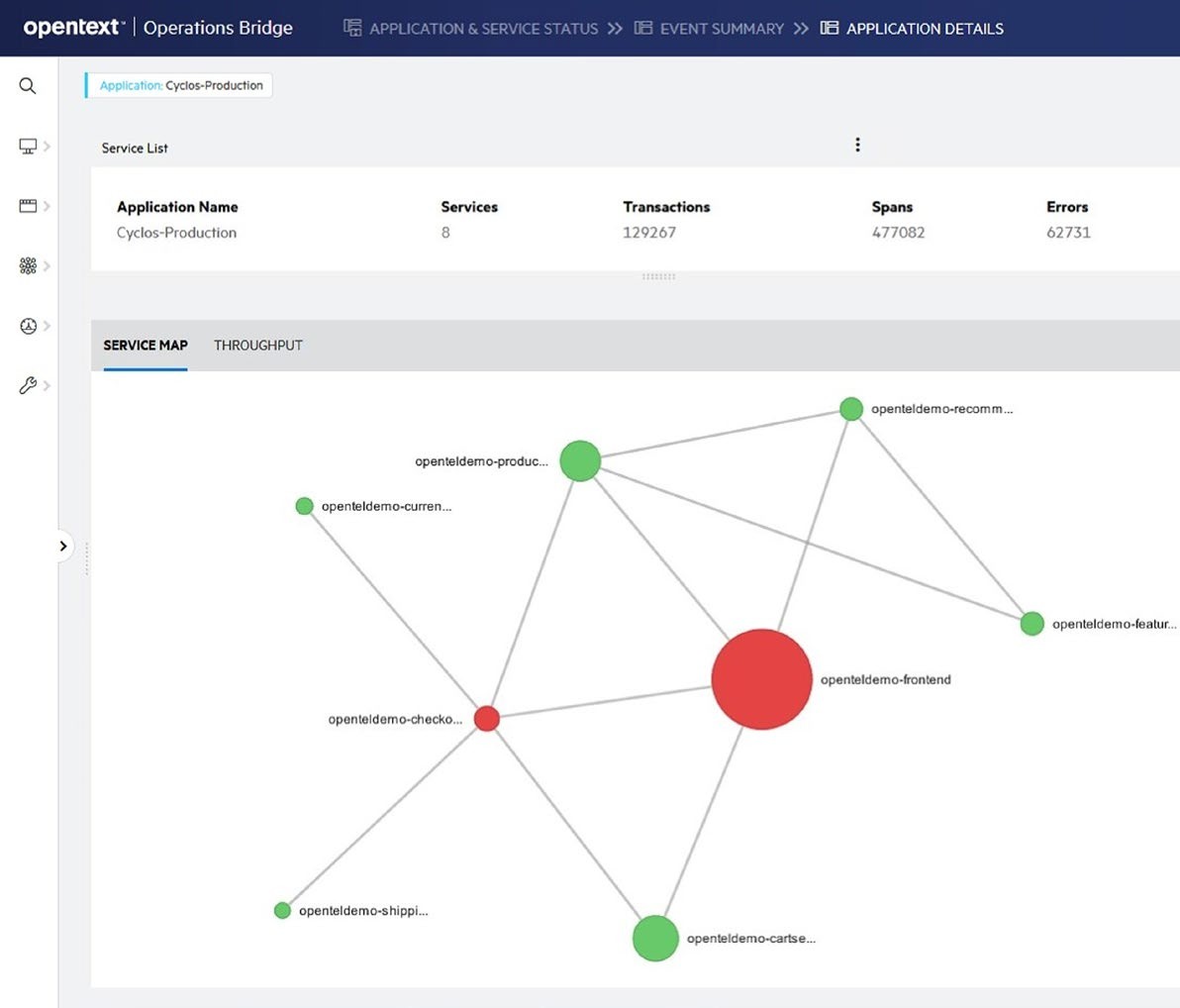
The application layer complements the infrastructure layer: infrastructure shows which component is degrading, applications show which transaction and which code are affected. Users include ITOps, DevOps, cloud operations, SREs and developers.
Service layer: OpenText Service Management
OpenText Service Management (SMAX) is an AI-powered IT and enterprise service management (ITSM, ESM) platform where every incident, request and change is handled. It provides ITIL-certified process templates for incident, problem, change, release, knowledge and service requests, and extends to HR, facilities, finance, legal and procurement.
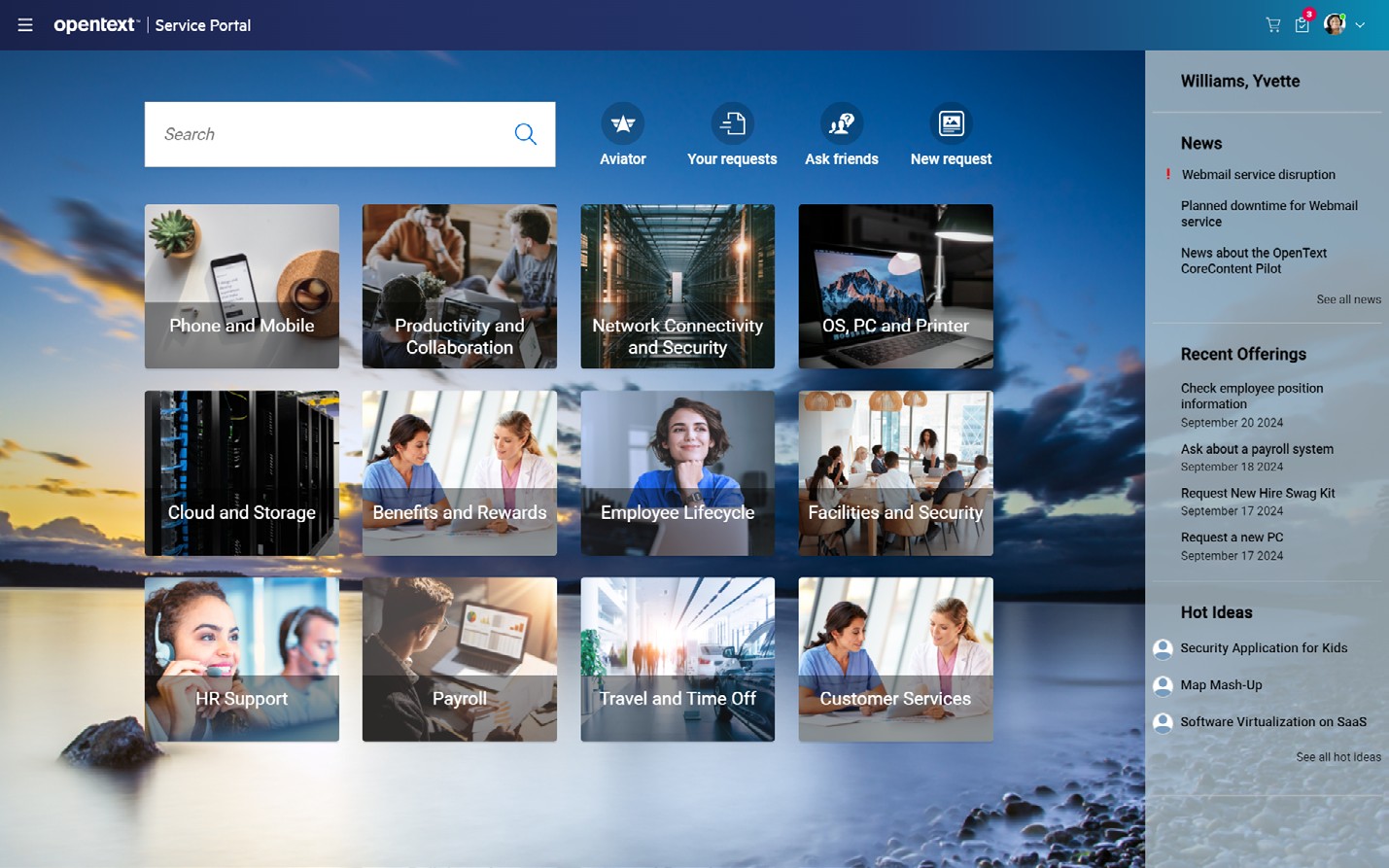
- AI-powered self-service: one service portal and mobile app; email, mobile and collaboration channels.
- Technician productivity: Aviator summarises tickets, suggests solutions, drafts knowledge articles and assesses change risk; automation from intake, routing and approval to closure.
- Codeless platform: configurations survive upgrades; the native CMDB is the source of truth for service dependencies; prebuilt connectors for security, cloud, collaboration and HR tools.
- Aviator on a private LLM: respects access rights and answers from the organisation's approved knowledge; every action is logged.
The Service Management Express SaaS edition includes unlimited ITSM processes, Aviator, the service portal, reporting, a configuration studio, multi-region data storage and a 99.9% availability SLA. Premium adds IT asset and procurement management, idea management and vendor management.
Choosing by need
| Organisation's need | Suggested product |
|---|---|
| Fault and performance monitoring of multi-vendor network devices for a NOC | Network Node Manager |
| Configuration change control and network policy compliance, on-premises | Network Operations Management |
| Hybrid networks (data centre, SD-WAN, cloud), AI diagnostics, SaaS or on-premises | Network Observability |
| One view of AWS, Azure, GCP, Kubernetes, VMware and on-premises resources | Infrastructure Observability |
| Tracing application and microservice performance without vendor lock-in | Core Application Observability |
| An ITIL service desk extended to HR, facilities and finance | Service Management |
| Closed-loop operations from alert to resolution and reporting | Observability layer plus Service Management |
CyberLotus services
- Assessment and advice: review current IT operations; choose products and the deployment model.
- ITIL process design: incident, request, change and CMDB; the flow from monitoring to tickets.
- Deployment and integration: install, configure and integrate with the organisation's existing systems.
- Training and operational support: handover to the IT team, technical support and version upgrades.
Compiled from OpenText's public Product Overview documents (November 2024 to June 2026). Figures are as published by OpenText; features, editions and deployment models may vary by version and should be confirmed for each proposal. OpenText, Aviator, SiteScope and SMAX are trademarks of Open Text Corporation; ITIL® is a registered trademark of AXELOS Limited.
Focused on your business.
Six products across four operations layers. Start with one layer and expand; every signal converges on tickets and the CMDB.
Network Node Manager (NNMi)
Unified fault and performance monitoring for multi-vendor networks; real-time topology with Spiral Discovery; distributed, federated architecture for large networks.
Network Operations Management
NNMi plus policy-based configuration management: changes overlaid on performance, unsaved-change detection, rollback and compliance audits.
Network Observability
One platform for hybrid networks: 3,500+ device types from 250+ vendors, logs, traffic flows, NetDevOps with Ansible and Git; Aviator diagnostics.
Infrastructure Observability
SaaS monitoring for multi-cloud and on-premises infrastructure; MVAD cuts alert noise; builds on your existing OpenText SiteScope.
Core Application Observability
OpenTelemetry-native application observability: traces, metrics, logs, automatic service maps and the four golden signals at code level.
Service Management (SMAX)
ITSM and ESM with ITIL-certified process templates; native CMDB, self-service portal, Aviator on a private LLM; Express and Premium SaaS editions.
A clear implementation journey.
Tools only pay off when operations processes are right. CyberLotus supports you from assessment to operations.
Assess
Review current IT operations tools and processes; choose products and SaaS or on-premises.
Design processes
Design incident, request and change processes to ITIL; model the CMDB and the flow from monitoring to tickets.
Deploy and integrate
Install, configure and discover devices; integrate monitoring with Service Management and existing systems both ways.
Train and support
Train administrators, technicians and users; operational support and version upgrades.