
OpenText Information Archive
Archive data, retire legacy applications.
OpenText Information Archive (InfoArchive): compliant archiving of data and documents from legacy applications, application decommissioning; on-premises or cloud.

- 01Unified archiveDatabases, applications, documents
- 02Retire legacy appsData stays fully searchable
- 03Lifecycle complianceRetention · holds · disposition by policy
- 04Open formatsOAIS ISO 14721 · XML · WORM
- 05Flexible deploymentOn-premises · private cloud · AWS, Azure, GCP
What does OpenText Information Archive help with?
OpenText Information Archive keeps structured data and unstructured documents in one compliant, central archive, so organisations can retire legacy applications while users still find historical data.
One archive for many apps
Archive databases, applications and documents of any data type on one central, low-cost platform.
Retire legacy applications
Drop the maintenance, support and hardware costs of outdated applications while data stays fully accessible.
Secure, role-based access
View, browse and search archived data through familiar web interfaces with fine-grained permissions.
Lifecycle compliance
Retention policies, legal holds and controlled disposition; encryption, masking and audit trails.
Open, long-term formats
Built on the OAIS model (ISO 14721), with data stored as XML and no vendor lock-in.
On-premises or cloud
Run on-premises, in the OpenText private cloud, or on AWS, Google Cloud or Microsoft Azure.
What is OpenText Information Archive?
OpenText Information Archive (formerly OpenText InfoArchive) is a modern archiving solution, deployed on-premises or used as a cloud service, that lets organisations archive both structured data and unstructured documents in a compliant, highly accessible, scalable and cost-effective way.
Organisations constantly weigh the cost and effort of keeping data in legacy applications only for compliance and look-ups (maintenance fees, support, hardware) against the value of keeping that data accessible and usable. Long retention periods keep data running needlessly on many systems. Archiving is the obvious answer, but new processes can disrupt operations and rigid security worries IT. As a result, data often stays in expensive, outdated applications and loses value over time.
With Information Archive, users reach historical data and documents through familiar, role-based interfaces without disruption, while the organisation can retire the source application.
Key benefits
- Archive to the cloud or on-premises.
- Archive databases, applications and documents of any data type.
- Retire outdated legacy applications.
- View, browse and search archived data securely.
- Manage retention, holds and disposition by policy.
One archive platform, two use cases
Active archiving moves completed business data out of systems in operation, reducing system load, shortening backup windows and cutting infrastructure costs. Application decommissioning moves all data from a legacy application into the archive, then switches the application and its infrastructure off, removing maintenance costs while staying compliant.
Accelerate cloud migration
Organisations can save budget with highly scalable cloud services by archiving on Information Archive, its Cloud Edition or private cloud infrastructure to consolidate legacy data and applications.
Start real digital transformation
Retiring outdated applications and systems modernises business processes while keeping productivity and compliance. Complete historical business data is always one click away.
Instant, secure access to historical data
The archive can be built into existing applications and processes through web interfaces, giving users fast access to archived information and keeping data ready for analytics and machine learning projects.
Access all information, structured and unstructured
Users can archive any type of file and data, including structured data from commercial and custom-built applications. Structured data and document metadata are organised into business views in one central, low-cost, compliant archive.
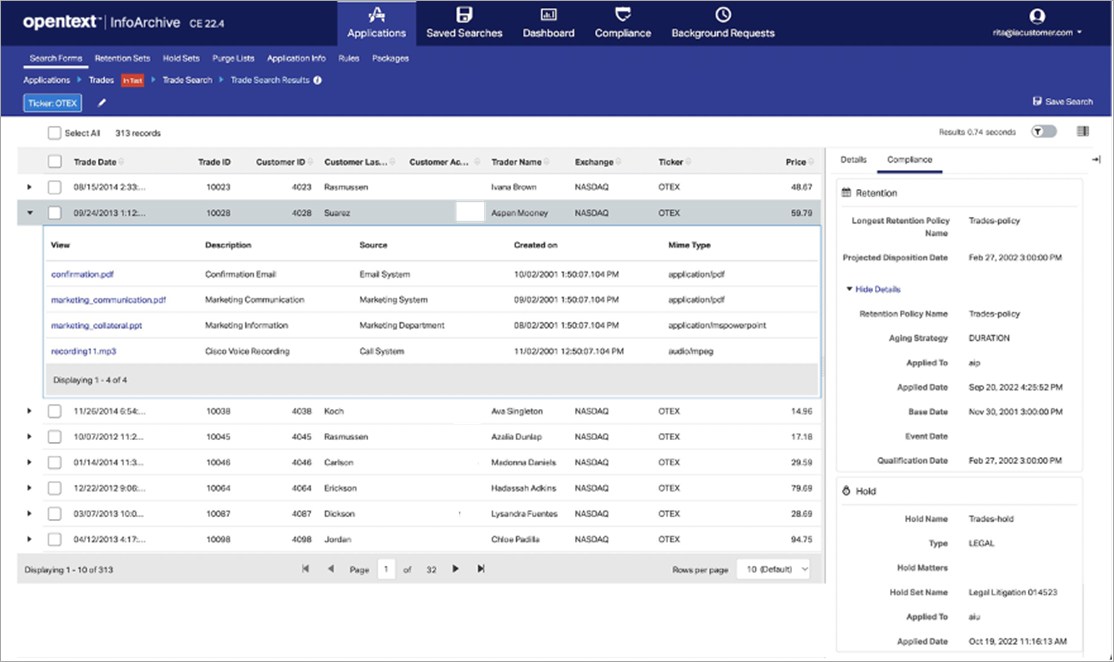
Modern interface, flexible access control
Data is organised into functional, role-based views tied to ongoing business processes. A 360-degree view shows active and archived data together through OpenText Content Management (Extended ECM).
One system can hold an unlimited number of archived data sets, each with its own lifecycle and security. The archive is accessible from integrated applications such as OpenText Content Management and OpenText Documentum Content Management. Dashboards give administrators an overview of compliance, capacity and archive volume.
"We must meet many compliance requirements, such as retention, data encryption and time stamping, across many application systems. OpenText Information Archive helps us address all of them on a single platform."
Michael Leung, Chief Information and Operations Officer, China CITIC Bank International
Compliance control across the data lifecycle
The archive meets the encryption, privacy and retention requirements of information governance policies, unifying compliance for structured and unstructured data from many applications.
| Area | Capabilities |
|---|---|
| Retention management | Retention policies apply automatically on ingestion and protect data for the required period; legal holds stop disposition and take precedence over retention; controlled disposition deletes data through a defined process when retention ends. |
| Integrity | Audit trails record every system and user action; archived data is immutable; chain of custody records when data was archived, from which source and how many records. |
| Privacy | Encryption of sensitive data by policy; masking of part or all of a record; access control so only authorised people see the data. |
Open formats based on the OAIS standard
The archive is standards-based and follows the Open Archival Information System (OAIS) model, ISO 14721, so data stays usable in the long term. Data is stored as XML, keeping its integrity without vendor lock-in, so the source application can be retired for good.
| OAIS function | How Information Archive implements it |
|---|---|
| Ingest | Independent of data schema and ETL tool; synchronous or asynchronous ingestion. |
| Archival storage | Data and content stored as one logical unit (archival information package, AIP) with chain-of-custody information. |
| Data management | XML database for search, export and reporting; partitioning to meet service levels. |
| Preservation planning | Data in open standard XML, content in any binary format; hash values prove integrity; WORM storage support. |
| Access | Synchronous and asynchronous search; export management; fine-grained permissions by user group. |
| Administration | Compliance management with many retention and hold options; job, store, capacity and encryption management through the interface and REST API. |
Product capabilities
| Capability | Description |
|---|---|
| Unified archive platform | One central archive for many applications; unstructured content can be stored on-premises, on Amazon S3 or on Microsoft Azure Blob Storage. |
| Data ingestion and conversion | Use any extract, transform, load (ETL) tool for structured data, or OpenText's rapid conversion tools. |
| Role-based views | Business and role-based views of data; secure search and browsing without keeping the source application. |
| Security and privacy | Policy-based encryption; data masking; role-restricted views. |
| Records lifecycle management | Full records lifecycle under the organisation's retention policies; each data set has its own policies and security. |
| Content management integration | 360-degree view in OpenText Content Management; long-term archiving with integrated access and search for OpenText Documentum Content Management. |
| Statements and print streams | Ingest and index AFP print streams and render them as PDF on the fly, ideal for financial statements and customer correspondence. |
| Monitoring | Dashboards for compliance, capacity and archive volume. |
Deployment options
- Private cloud managed by OpenText.
- On-premises software operated by the organisation.
- Infrastructure partner clouds: OpenText Private Cloud, AWS, Google Cloud, Microsoft Azure (private or public).
During system upgrades, Information Archive replaces legacy infrastructure while data stays fully accessible.
When to consider Information Archive
| Situation | Signs |
|---|---|
| Application decommissioning | Cost and technical burden of legacy applications; maintenance renewals; mergers and reorganisations; software out of support. |
| Cloud migration | Data centre consolidation or migration; application transformation; new enterprise application roll-outs. |
| Active archiving | Backup windows too short; declining system performance; rising infrastructure, storage and backup costs. |
| Compliance and reuse | Central compliance management; new data regulations; access for new users; controlled analytics. |
Typical use cases
- Banking, finance and insurance: archive transaction data, customer records and statements from legacy core systems; fast look-ups for customers, auditors or regulators.
- Government agencies: keep the data of legacy information systems when systems are consolidated, upgraded or replaced, so it remains searchable for the retention period.
- Electronic invoices and vouchers: archive large volumes of invoices and vouchers with long retention periods, offloading systems in operation.
- Content management consolidation: migrate only active content to the new platform; move historical content to the archive, then retire the old systems.
For documents and records in active business processes, see OpenText Content Management; for an end-to-end electronic records solution, see electronic records management (ERMS).
About OpenText
OpenText (NASDAQ: OTEX, TSX: OTEX), founded in 1991 and headquartered in Waterloo, Canada, is an information management software company providing content management, archiving, information governance and security platforms to organisations worldwide. CyberLotus Joint Stock Company is an OpenText partner in Vietnam, providing OpenText Information Archive with consulting, deployment, integration and operational support for government agencies and enterprises.
OpenText, OpenText Information Archive, InfoArchive, Content Management, Extended ECM and Documentum are trademarks or registered trademarks of Open Text; other trademarks belong to their respective owners. Screenshots are illustrative. Specific features depend on edition, configuration and licensed scope.
Focused on your business.
Core capabilities of OpenText Information Archive, from ingestion to search and disposition.
Unified archive platform
One central archive for many applications; unstructured content on on-premises storage, Amazon S3 or Azure Blob Storage.
Data ingestion and conversion
Use any ETL tool for structured data, or OpenText's rapid conversion tools.
Role-based views
Business views of archived data; secure search and browsing without keeping the source application.
Security and privacy
Policy-based encryption, data masking and role-restricted views.
Records lifecycle management
Retention, holds and disposition per data set; dashboards for compliance, capacity and volume.
Statements and print streams
Ingest and index AFP print streams with on-the-fly PDF rendering, ideal for financial statements.
A clear implementation journey.
CyberLotus is an OpenText partner in Vietnam, supporting you from application review to operations.
Review and advise
Review the legacy application portfolio and the data to archive; advise on retention, hold and disposition policies.
Extract and convert
Extract and convert data and documents; reconcile counts and integrity before the source application is switched off.
Deploy and integrate
Deploy on-premises or in a private cloud; integrate with business applications and content management systems.
Train and support
Train and hand over to administrators and users; post-deployment support.
Learn more about OpenText Information Archive.
Documents for download.
Brochure OpenText Information Archive
Lưu trữ dữ liệu và ứng dụng cũ
Download